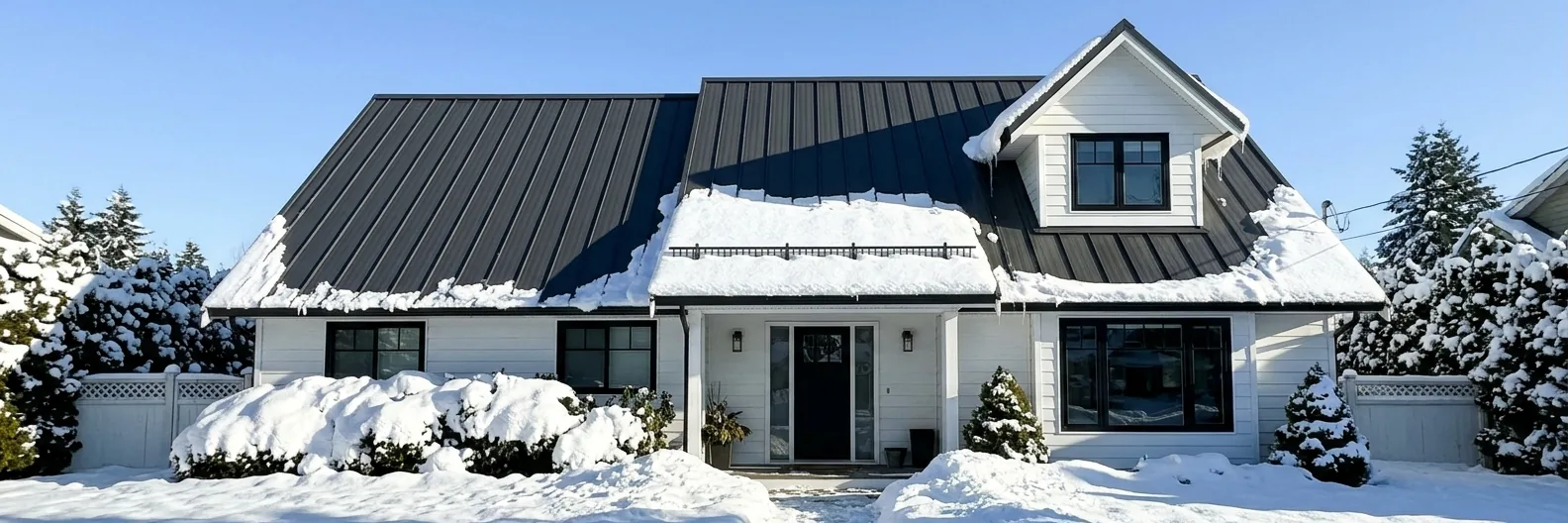
Snow slides off a metal roof. On a barn in Agassiz that is a feature: the roof clears itself and never carries a season's load. Over the front door of a house on the North Shore it is a hazard, because the whole slope can let go at once onto the step, the car or the gas meter. Snow guards are how you decide where the snow goes. Ice at the eaves is a separate problem, one that guards do not fix and ventilation does.
The Lower Mainland gets less snow than most of Canada, and most of it in a few storms. Vancouver airport averages 36.6 cm a year, the hillside neighbourhoods and the eastern Fraser Valley get more, and what falls here is wet and heavy. The building code's design ground snow loads for Metro Vancouver run from 2.6 to 2.9 kPa, the weight a roof structure here is built to carry. This guide covers why snow slides, where guards go and which kind to use, ice at the eaves and the ventilation behind it, and which areas need retention most.
Why snow slides off metal
An asphalt or cedar roof is rough, and snow bonds to it until it melts. A metal roof is smooth, and as soon as sun or attic warmth melts a film of water at the panel surface, the snowpack is sitting on a lubricated slide. It can release as one slab, all at once, with the force of its full weight. Standing seam, metal shingles and exposed-fastener panels all do it; the seams and ribs slow it a little but do not hold it.
Industry guidance is blunt: there is no way to predict a dangerous rooftop avalanche. The timing depends on temperature, sun, pitch, orientation and how wet the snow is. Planning for it means deciding, before the first snowfall, where sliding snow is acceptable and where it is not.
Where snow guards go
Guards do not stop snow from leaving the roof. They hold it in place so it melts and drains away as water, or comes off in small amounts. Where you need that:
- Above every entry door and walkway, including side doors and basement entries.
- Above driveways and parking where cars sit under the eave, and above decks, patios and hot tubs.
- Above gas meters, heat pumps, air conditioning units and electrical services.
- Where an upper roof sheds onto a lower roof, a porch roof or a bay window.
- Above gutters on slopes that face the sun, because sliding snow tears gutters off the fascia.
- Along a property line where the slope sheds onto a neighbour's path or car.
Slopes that shed onto a lawn, or the far side of a barn where nobody stands, need nothing. On many houses a single row over the entries and the driveway is the whole job; on a complex roof with dormers and lower roofs there may be several rows. We place them per roof under our snow guards and accessories service.
Clamp-on, stick-on and bent sheet metal
There are three kinds of snow retention, and they are not equal.
Bent sheet-metal stops are the cheapest: small angles of roofing metal, screwed or glued to the panel. Industry guidance notes that they often bend, fold and collapse under load. A guard that collapses in the one storm that matters was not worth fitting.
Stick-on guards are small polycarbonate or metal pads glued to the panel face. They go on without penetrations, which sounds right. Two problems. Their holding power is whatever the adhesive gives in a wet BC winter, and a failed pad takes the snow with it. And metal roof paint warranties list adhered add-ons among their exclusions, so a glued guard can void the paint warranty on the panel it is stuck to.
Engineered clamp-on systems are what we install. On a standing seam roof the clamp grips the seam itself, with set screws that dimple rather than pierce the metal, so there is no hole in the roof. A continuous bar or rail runs through the clamps along the eave, and the system is rated by its manufacturer for the seam profile, the pitch and the snow load. The same family of seam clamps is used for solar mounting, with published holding capacities from about 300 pounds to about 4,000 pounds per clamp depending on the seam and the clamp. Engineered systems exist for exposed-fastener profiles too, fastened at the ribs through to the structure.
Snow retention is quoted on site: the length of eave, the number of rows, the clamp for your seam and the structure under it.
Snow guards and the roof structure
A guard changes what the roof carries. A self-clearing roof sheds its load; a guarded one keeps it, and the structure has to hold a full season's snow the way a shingle roof would. On a house built to the code's design snow load (2.6 kPa in Port Coquitlam, 2.7 in Burnaby, 2.9 in the Burnaby Mountain area) that is what the trusses are for. On an older barn, carport or shed roofed in metal precisely so it would never carry snow, adding guards without checking the framing is a mistake; there the answer is often to let the roof shed and guard only the doorways.
Ice at the eaves
Ice dams are a heat problem, not a snow problem. Heat escaping from the house into the attic warms the underside of the roof, snow melts from below, the water runs down to the cold overhang and freezes. The ice builds into a ridge, meltwater pools behind it, and on a shingle roof it finds its way under the shingles. A metal roof does better, because water cannot get under a seamed panel the way it gets under a shingle, but it can still back up over the hem at the eave, and the ice itself tears at gutters and drip edge.
The BC Building Code requires eave protection on shingle, shake or tile roofs: a membrane running from the roof edge at least 900 mm up the slope and to a line at least 300 mm inside the inner face of the exterior wall. It also exempts regions with 3,500 or fewer degree-days, and every Metro Vancouver and Fraser Valley municipality is below that line. Burnaby sits at 2,735 degree-days, the Burnaby Mountain area at 3,100, Port Coquitlam at 2,810, and Abbotsford, Chilliwack, Langley, Mission and Surrey are in Climate Zone 4 at under 3,000. Hope is in Climate Zone 5 at 3,000 to 3,999, still under the trigger. So eave protection is not code-required anywhere in our area.
The roofing industry's own position is that it belongs on every shingle roof anyway, and our practice is to run a self-adhered membrane at the eaves and in the valleys under every metal roof we install, because the code minimum and a dry house in a cold week are not the same thing. Targeted ice and water shield at eaves and valleys typically runs $700 to $3,000 per job, with full-roof coverage at $3,500 to $7,000 and up; on a metal re-roof we build the eave membrane into the quote.
Ventilation: the real fix for ice
If the attic stays as cold as the outside air, the snow melts from the top in the sun rather than from below, and ice dams do not form. That is what attic ventilation is for. The BC Building Code calls for unobstructed vent area of at least 1/300 of the insulated ceiling area, or 1/150 where the roof slope is less than 1 in 6 or the roof is built with roof joists, as in a cathedral ceiling. The vents are to be distributed uniformly on opposite sides of the building, with at least 25% of the required opening at the top of the space and at least 25% at the bottom, and there must be at least 63 mm of clear space between the insulation and the underside of the sheathing, with baffles at the eaves keeping a 25 mm air path open.
In practice that means soffit intake plus a ridge outlet, and we build a ridge vent into the metal ridge cap as standard. The common failures on 1970s to 1990s houses are insulation stuffed into the eaves blocking the intake, bathroom fans venting into the attic, and a ridge with no outlet. Fixing those during a re-roof is cheap by comparison: typical prices run $100 to $300 per box vent installed, from about $350 for a short ridge vent to $3,000 for a full ridge system, $250 to $2,000 for soffit intake vents, and $300 to $2,000 for a ventilation upgrade during a re-roof. See our roof ventilation service.
Which Lower Mainland areas need snow guards most
Elevation decides it. The flats of Richmond, Delta and Vancouver see snow on a handful of days a year, and most houses there need guards only over the front door, if at all. The places where we fit full systems:
- The North Shore: North Vancouver above the Upper Levels Highway, and West Vancouver's British Properties and the slopes toward Cypress.
- The Tri-Cities hillsides: Westwood Plateau and Burke Mountain in Coquitlam, and the Burnaby Mountain area, which the code data shows as the coldest part of Burnaby.
- Silver Valley and the hillsides above Maple Ridge.
- The Mission and Abbotsford hillsides.
- Promontory and the Eastern Hillsides in Chilliwack.
- Agassiz and Harrison Hot Springs, where the valley narrows and the Fraser's outflow winds funnel through.
- Hope, the one Lower Mainland municipality in Climate Zone 5, where snow stays on roofs longer than anywhere else we work and every eave over a door or a vehicle should have retention.
In these areas, treat snow retention as part of the roof, not an accessory to add after the first winter.
Gutters, downspouts and sliding snow
A slab leaving a metal roof takes the gutter with it if the gutter stands above the roof line. On metal roofs we hang gutters low, so the plane of the roof passes over the gutter's front edge, and we fit guards above gutters on any slope that sheds heavy snow. It is the difference between a roof that clears itself for 40 years and one that drags its eavestrough off in a bad winter.
Next step
If you are deciding on a metal roof in one of the hillside areas, book a free estimate and we will walk the eaves with you, mark where retention belongs, check the attic venting and quote it all as one job. For a budget range on the roof itself, the estimate tool emails you a price range in a few minutes; snow guards are added at the site visit.
Sources
- S-5, Northern Ontario winters are no match for ColorGard
- Vancouver Building By-law 2019, Section 9.26 Roofing
- BC Building Code 2018, Section 9.19 Roof spaces
- City of Burnaby, Climatic and seismic values for building design
- Better Homes BC, Climate zone FAQ
- Climate of Vancouver, Environment and Climate Change Canada 1991 to 2020 normals