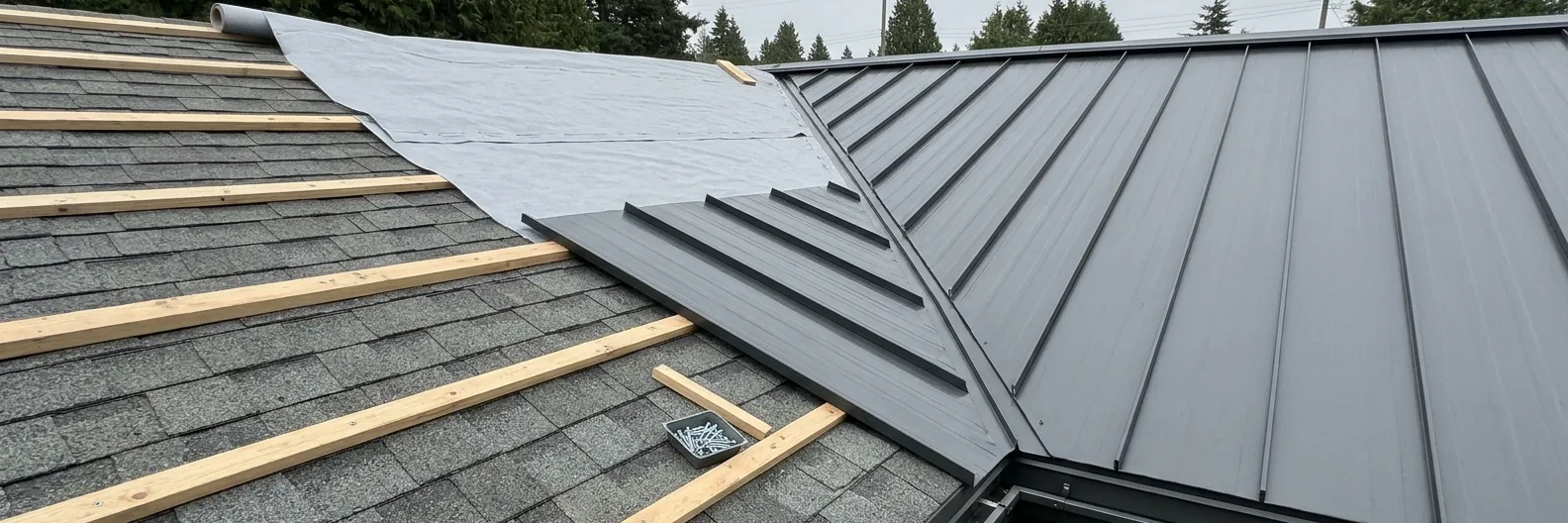
Yes, in the right conditions. Nothing in the BC Building Code's Part 9 roofing rules forbids a new metal roof over an existing layer of asphalt shingles: the code governs the new roofing, and whether an overlay is acceptable is a matter for the municipality and the panel manufacturer. Industry guidance is consistent: one flat, dry layer of shingles on a sound deck, with an underlayment between the shingles and the metal, and every leak or soft spot fixed first. Two layers, cedar shakes, curled or buckled shingles or any doubt about the plywood mean a tear-off.
The saving is real but smaller than people expect. A one-layer tear-off runs $1 to $3 per square foot, about $2,400 on a 2,000 square foot roof, and skipping it saves $1,500 to $4,000. Against a standing seam roof at $24,000 to $40,000 for that same roof, the overlay saves a small share of the job. All prices here are CAD, installed, before GST, at typical 2026 Lower Mainland prices.
What the code says
The BC Building Code 2024 came into effect on March 8, 2024 and applies to projects whose permit was applied for on or after that date; the City of Vancouver uses its own building by-law, whose roofing section mirrors the code. Neither text prohibits a new roof over an old one. Section 9.26 sets minimum slopes, fastening, flashing and eave protection for the new roof covering, and a metal roof over shingles has to meet all of those just as it would over bare plywood.
Two rules carry over to an overlay directly. The minimum slope for profiled metal roofing and for sheet metal shingles is 1 in 4, a 3:12 pitch, with lower slopes permitted only under specific conditions in the same article. And the attic ventilation rule, one square foot of unobstructed vent area for every 300 square feet of insulated ceiling with at least a quarter of it at the top of the attic and a quarter at the bottom, does not change because the old roof stayed on. If the attic was short of intake before, it still is.
The one relevant model-code statement comes from the US residential code, which allows a new roof over an old one where the new roof does not rely on the existing roof covering for support. That is the principle overlay instructions follow: the metal is fastened through the shingles into the deck, and the shingles are simply left in place.
Permits are a separate question, and the answer depends on where you live. Richmond says installing, replacing or repairing roofing does not need a building permit, and the City of Vancouver lists installing roofing among projects that do not need one. Harrison Hot Springs goes further and lists recovering an existing roof among projects that do not need a permit. Surrey's permit page never mentions roofing and its bylaw defines regulated construction to include repair, so there we call the Building Information Line first. Our area pages quote each municipality's own wording.
Why one layer, and only one
Industry guidance allows metal over asphalt "provided there are not too many layers"; some jurisdictions permit one, some two. We stop at one, for three reasons.
First, the fasteners. A screw or clip has to pass through the shingles and bite into the plywood. One layer of shingles is a thin, predictable thickness; two layers are thicker, softer and uneven, and the fastener's grip in the deck is what holds the roof on in a Fraser Valley outflow wind.
Second, the surface. Standing seam pans are wide and flat, and every ridge of a curled shingle underneath shows through in raking light. One flat layer can be dealt with; two cannot.
Third, the next roof. Every layer left on is a layer the next crew removes, and each additional layer adds $0.50 to $1.50 per square foot to that tear-off. A metal roof pushes that day a long way off, but the deck under it will not be seen until it comes.
Cedar shakes are never a candidate. Shakes sit on spaced boards so they can dry from below, and metal needs a continuous deck, so a cedar roof means a tear-off at $3 to $5 per square foot, plus a new plywood deck at $2 to $5 per square foot.
The underlayment is not optional
Shingle granules are abrasive, and the guidance is clear that an underlayment goes over the shingles before any metal does, with synthetic preferred, because granules can abrade and corrode the back of the panel as it expands and contracts. The underlayment also gives the roof a second drainage plane: water that gets past a flashing runs down the membrane to the eave instead of into the shingles.
We use a high-temperature synthetic underlayment over the whole roof, overlay or not, at $0.75 to $1.50 per square foot, and include it in our panel price. At the eaves and valleys we add a self-adhered ice and water membrane, $700 to $3,000 per roof depending on how much eave and valley there is. The code's eave protection rule applies to shingle, shake and tile roofs and is switched off in regions with 3,500 or fewer degree-days, which covers the Lower Mainland, so it is not a code requirement here. The roofing industry still recommends it and so do we, particularly on hillside and North Shore roofs that hold snow.
The deck decides
An overlay is only as good as the plywood nobody can see. Before we agree to one we walk the roof and feel for soft spots, look in the attic for daylight, staining and dark sheathing around vents and chimneys, and check the roofline for sag. Guidance from the metal industry says the same: leaks, "sagging decking or buckling trusses" have to be fixed first, and fixing them means opening the roof.
Where the deck is sound, an overlay works. Where there are soft spots, we tear off. Repairing a few sheets through a layer of shingles is a poor job; with the shingles gone, patches run $80 to $150 per sheet and a full re-deck $2 to $5 per square foot, and the result is a roof we can stand behind.
Which metal shingles and standing seam systems suit an overlay is a manufacturer question. Some interlocking metal shingle systems are designed to go over one layer of shingles. Standing seam over shingles is done, but the flat pans show the surface beneath them, so we specify striated panels and a smooth underlayment, or we tear off.
When to tear off anyway
- Two layers of shingles. Always.
- Cedar shakes or shingles. Always, and the deck is replaced.
- Soft spots, sag or staining in the attic. The deck needs to be seen.
- Curled, cupped or buckled shingles. They will telegraph through, and they tell you the roof has been wet for a long time.
- An active leak you cannot trace. Covering it does not find it.
- Ventilation or insulation work is planned. It is easier with the roof open, and most 1960s to 1990s houses are short on intake. See our roof ventilation page.
- The manufacturer's instructions for your panel say so. Their warranty follows their instructions, not ours.
- You want the long warranty with a clean conscience. A finish warranty covers the paint, not the plywood. If you are paying for a 40-year roof, knowing what is under it is worth a few thousand dollars.
What an overlay saves, in numbers
| Item | One-layer tear-off | Overlay |
|---|---|---|
| Tear-off and disposal | $1 to $3 per sq ft | $0 |
| Worked example, 2,000 sq ft roof | About $2,400 | $0 |
| Landfill tipping | Near $147 per tonne, adding $600 to $1,200 | $0 |
| Typical saving from skipping tear-off | $1,500 to $4,000 | |
| Underlayment | $0.75 to $1.50 per sq ft | Same |
| Deck repairs | Patches $80 to $150 per sheet, as found | Not possible until later |
| Metal roof itself (standing seam or metal shingles) | $12 to $22 per sq ft | Same |
On a 2,000 square foot standing seam roof at $24,000 to $40,000, the overlay saving of $1,500 to $4,000 is between about 4% and 17% of the job, depending on which ends of the ranges you take. Where the deck is known to be good, that is money well kept. Where the deck is unknown, it is a small discount for not looking. Our cost guide has the full tables, and our re-roofing to metal page describes how we handle both cases.
What we do
We will install over one layer of asphalt shingles when the deck is sound, the shingles lie flat, the attic is dry, the slope meets the code minimum for the panel, and the manufacturer's instructions allow it. We put a synthetic underlayment over the shingles, ice and water membrane at the eaves and valleys, new drip edge and flashings, and we photograph the roof before and after. When any of those conditions fails, we recommend a tear-off and show you why with photographs. We do not install over two layers or over cedar.
Next step
If you are weighing an overlay against a tear-off, the estimate tool gives you a range for the metal roof itself in a few minutes, and the tear-off line is easy to add from the table above. For a decision on your own roof, book a free estimate: we walk the roof, look in the attic, and tell you in writing whether an overlay is sound on your house.
Sources
- Metal Roofing Source, Installing a metal roof over shingles
- Vancouver Building By-law 2019, Section 9.26 Roofing
- Province of BC, 2024 BC Codes