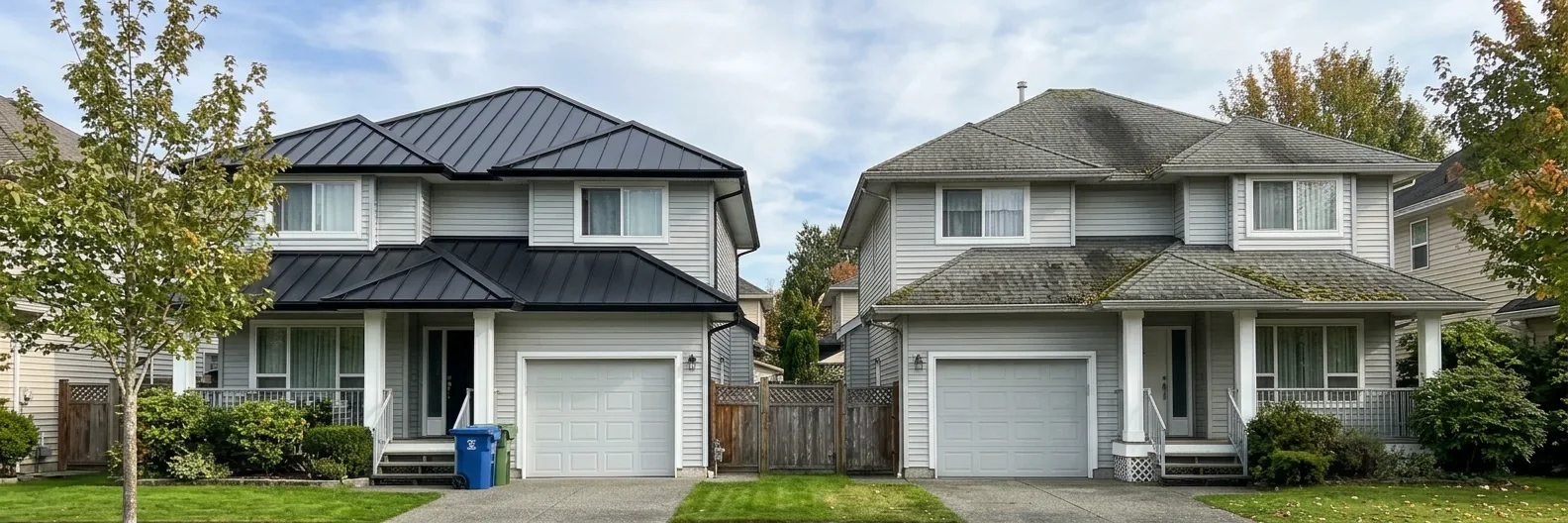
Architectural asphalt shingles cost $5.50 to $9.50 per square foot installed in the Lower Mainland; steel standing seam costs $13 to $22 and metal shingles $12 to $22, at typical 2026 Lower Mainland prices. Metal is roughly double up front. Industry lifespan charts put metal at 40 to 80 years against 15 to 25 for basic asphalt, so one metal roof covers the life of two or three shingle roofs, and it does so without the moss treatment that a shaded shingle roof in this climate needs every year.
That is the short version, and it favours metal for a house you intend to keep. The longer version has a few places where shingles are the better answer, and since metal is all we install, we would rather name them here than have you find out later. Everything below is CAD, installed, before GST.
Cost, side by side
| Architectural asphalt | Standing seam steel | Metal shingles | |
|---|---|---|---|
| Installed, per sq ft | $5.50 to $9.50 | $13 to $22 | $12 to $22 |
| Premium option | Class 4 or designer shingles $7 to $12 | Aluminum $18 to $28 | Interlocking aluminum $16.64 to $21.43 on BC contracts |
| 2,000 sq ft roof | $11,000 to $20,000 | $24,000 to $40,000 | Typical whole house $20,000 to $35,000 |
| Tear-off of one layer, added | $1 to $3 per sq ft | $1 to $3 per sq ft | $1 to $3 per sq ft |
Exposed-fastener metal panels at $8 to $14 per square foot narrow the gap, but on a house they are a budget choice with maintenance of their own, and most homeowners comparing metal with shingles mean standing seam or metal shingles.
One warning from the shingle side of the market: an asphalt quote under $4 per square foot is usually cutting corners. Cheap shingles exist, but a cheap shingle roof is usually a thin one.
Lifespan in the Lower Mainland's weather
The numbers above are not local; there is no Lower Mainland service-life study for either material. What the general figures say is this: a basic asphalt roof lasts 15 to 25 years, a Canadian insurance source gives 15 to 30 depending on quality, and an inspectors' chart puts architectural shingles at 30 under good conditions. Metal is 40 to 80 years in the same charts.
The local factor is water. This region's shingle roofs spend most of the year wet, and shade slows a roof's drying after rain. Shingles that stay damp grow moss, and in our experience moss works under the tabs and holds water against the mat. Metal has nothing for moss to root in.
What limits a metal roof is its finish, not its structure. PVDF paint warranties run 20 to 40 years for film adhesion, with chalk and fade covered for 10 to 30 years, and the Galvalume steel under the paint normally carries a 25.5-year corrosion warranty. The exclusions matter on the coast: breaking surf exposure, corrosive runoff and contact with other metals are all outside the warranty, which is why we recommend aluminum on waterfront homes.
Moss, and what it costs each year
Moss is the hidden line in a shingle budget here. Annual moss treatment runs $300 to $800, soft-wash cleaning $350 to $900 a visit, and zinc strips at the ridge $3 to $6 per linear foot. Over a 20-year shingle roof that is a second, slower payment for the roof.
Two things make it worse. First, pressure washing is out: the US asphalt shingle manufacturers' association says high-pressure washing is likely to damage shingles and should not be used, and its Canadian counterpart says it is not recommended, so cleaning has to be done gently and often. Second, algae-resistant shingles, whose granules are treated with zinc or copper, inhibit growth only "for a period of time" by the Canadian association's own wording.
Metal roofs still collect fir needles and leaves in valleys and behind chimneys, and gutters still need cleaning. But there is no annual treatment, and no granules to scrub away.
Fire rating: a draw, with one exception
FireSmart BC recommends a Class A roof and lists asphalt shingles, metal and slate, clay or concrete tile as the materials that provide it. On fire, metal and asphalt are equal; both are Class A. The material FireSmart scores as hazardous is untreated cedar, which is why so many cedar roofs in the valley are being replaced with one or the other.
Where metal pulls ahead is the Class A rating lasting as long as the roof. A shingle roof is Class A too, but it is on its third set of shingles by the time a metal roof is halfway through its life. One practical note: Mission is the only Lower Mainland municipality we have confirmed with a FireSmart rebate that can include Class A roofing, at 50% of cost up to $1,000, and it applies to either material. The 2026 round is closed and the next window opens in February 2027.
The noise myth
A Swedish university study measured rain noise on different roofs and found metal "did not register a significantly higher sound level than conventional asphalt shingles"; the difference was about 6 decibels. Reported figures put rain on asphalt at roughly 46 dBA and on metal at 52 dBA, and most people cannot tell apart sounds less than 8 decibels apart.
The reason is the deck. On a house, the panels sit on plywood, underlayment, an attic and insulation, and the deck absorbs the sound. The loud metal roof people remember is a shop or barn with panels on open framing and nothing underneath. Our guide on whether metal roofs are noisy has the full numbers.
Resale and insurance
There is no reliable local figure for a resale premium on a metal roof, so we will not claim one. What the record does show is how insurers treat roof age. Canadian insurance sources report that many insurers adjust roofs over 15 years old to actual cash value rather than replacement cost, and that a roof over 20 years old may have limited or no coverage for its own failure, with insurance application forms asking the age of the roof.
For a buyer, that means a 15-year-old shingle roof is already a question on the insurance form, while a 15-year-old metal roof has most of its life ahead of it. Some metal roofing systems also carry a limited warranty that transfers once to the next owner. When you sell, a roof that will not need replacing for decades is a plain fact a buyer's inspector can confirm, and that is worth more than any claimed percentage.
Weight
We have no reliable weight per square foot for either material, so we will not quote one. The useful fact is that metal is light enough to be installed over an existing layer of asphalt shingles where the deck and the manufacturer allow it, which tells you it does not add a load the house was not built for. Our guide to metal over shingles covers when that is sensible.
When shingles still win
We install metal and nothing else, so take this as the list we give people in person:
- You are selling within a few years. A shingle roof at $11,000 to $20,000 on a 2,000 square foot house gets the house sold with a new roof. Metal at $24,000 to $40,000 is paid back over decades you will not be there for.
- The budget is the deciding factor today. Shingles cost half as much now. A metal roof costs less over 50 years, but only if you can fund it this year.
- A strata or neighbourhood needs a match. Where a strata council requires every roof to match, or a heritage street is all shingle, a metal roof may not be approved.
- The roof is a low-slope asphalt candidate. The BC code allows asphalt shingles in low-slope application down to 1 in 6 (2:12) with extra coverage; profiled metal roofing's table minimum is 1 in 4 (3:12), with lower slopes permitted only under specific conditions. On some low roofs shingles or a membrane are the simpler answer.
- You want the lowest repair bill after a storm. A shingle roof is repaired by any roofer with a bundle of shingles. Metal repairs are specialised work, and we will tell you so.
Everywhere else, for a house you plan to keep 15 years or more, metal is the better buy. Our cost guide has the full price tables and the extras.
Next step
If you want to see what the two options cost on your own roof, our estimate tool gives you a metal range by email in a few minutes. When you want a firm number, book a free estimate: we measure the roof in person, check the deck and attic, and give you a written quote, and if shingles are the better fit for your situation we will say so.
Sources
- This Old House, How long does a roof last
- FireSmart roof fact sheet (Fraser Valley Regional District)
- McElroy Metal, Are metal roofs noisy when it rains
- Rates.ca, Roof replacement and home insurance