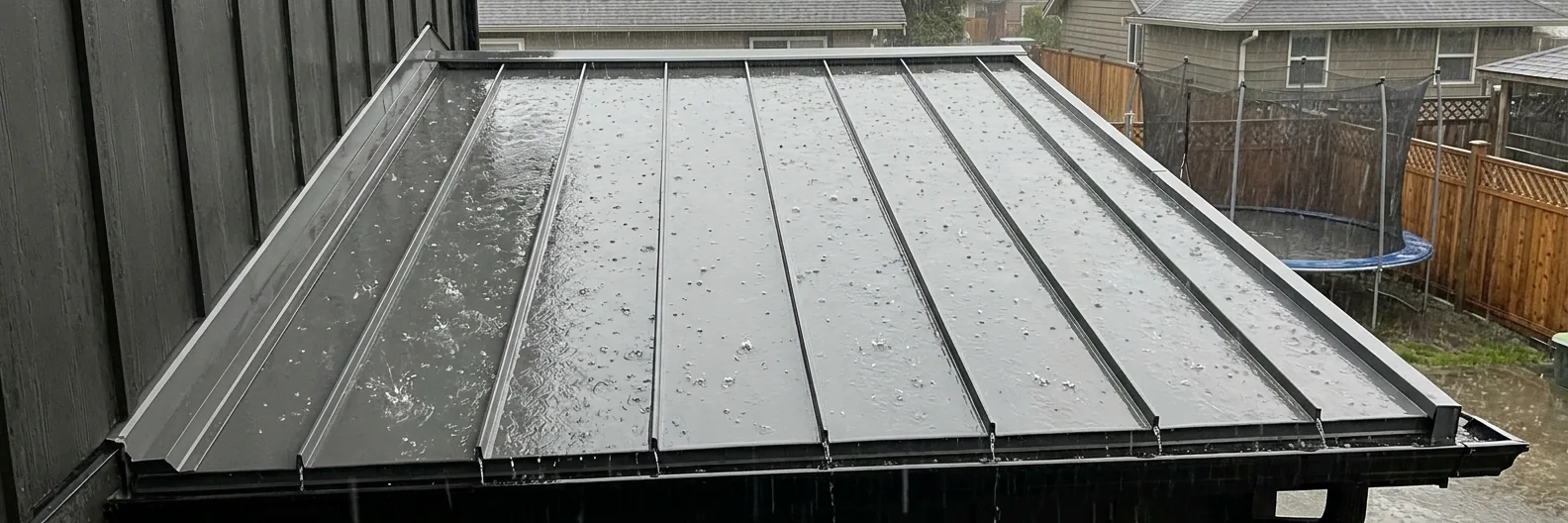
On a solid deck, a metal roof in rain is about 6 decibels louder than asphalt shingles, and most people cannot tell apart two sounds less than 8 decibels apart. That is the short answer, and it comes from measurement rather than opinion. The long answer is that the deck is the whole story: metal over plywood with underlayment, an attic and a ceiling is close to shingles, while metal screwed to open purlins over a shop floor is loud, and the two should not be confused.
Vancouver airport records rain on 166 days a year, so the question is a fair one here. This guide sets out the decibel figures, why a house roof and a barn roof sound nothing alike, what you will actually hear in a bedroom under a metal roof, and how to quiet a shop, a barn or a riding arena where the metal sits on open framing.
The measured figures
A study at the University of Luleå in Sweden tested rain noise on roofing assemblies and found that metal did not register a significantly higher sound level than conventional asphalt shingles; the difference between the two was only 6 decibels. The same study found that a metal roof installed over open framing registers a louder sound, and that the roof deck absorbs or muffles the sound.
Figures reported in the trade for roofs on a deck put rain on asphalt shingles at approximately 46 dBA and rain on a metal roof at around 52 dBA. Most humans cannot distinguish between sounds less than eight decibels apart, so the two roofs sit inside the range where a listener in the room below would struggle to say which was which.
| Rain noise, roof on a solid deck | |
|---|---|
| Asphalt shingles | About 46 dBA |
| Metal roofing | About 52 dBA |
| Difference | About 6 dB |
| Smallest difference most people can pick out | About 8 dB |
What the research does not give, and what we will not invent, is a figure for metal over open framing or for hail. It says open framing is louder and the deck muffles; it does not say by how much.
Why the deck is the whole story
Noise from rain is the panel vibrating like a drum skin. What decides how loud that is in the room below is what sits between the panel and your ear:
- The deck. Plywood or OSB sheathing under the panel damps the vibration at its source. The Swedish finding is exactly this: the deck absorbs or muffles the sound.
- The underlayment. A synthetic underlayment between panel and deck is one more layer of damping.
- The attic. On a house with an attic, there is an air space and a thick layer of insulation between the roof and the ceiling. That is the same arrangement that keeps your bedroom quiet under shingles.
- The ceiling. Drywall is the final layer.
Take any of those away and the roof gets louder. A shop with panels screwed straight to purlins has none of them, and the panel is the ceiling.
This is also why a metal roof installed over existing shingles is quiet: the old roof stays in place as another damping layer. Our guide to installing metal over shingles covers when that is allowed and when the old roof should come off.
Standing seam, exposed-fastener and gauge
On a house, standing seam and exposed-fastener panels sit on the same deck and sound much the same in rain. Two things do change the sound at the panel.
Gauge is one. A 24 gauge panel carries about 30% more steel than 26 gauge, and the heavier panel is stiffer and rings less. Standing seam for houses is nearly always 24 gauge; exposed-fastener panels are sold in 29, 26 and 24 gauge, and low-end agricultural sheets are normally 26 or 29. A 29 gauge sheet is the drum skin; a 24 gauge panel on a deck is not.
Fastening is the other. Standing seam panels are held by clips under the seams and can move as they warm and cool. Exposed-fastener panels are screwed through the face, hundreds of times. Neither is louder in rain on a deck, but a thin screwed panel over open purlins will drum and, on a hot afternoon, tick as it expands against its screws. We have no measurement for that, only ears.
What you will hear in a house
With a 24 gauge roof over a plywood deck, underlayment, a ventilated and insulated attic and a drywall ceiling, most people hear nothing in ordinary rain that they did not hear before. The places where a metal roof is more audible:
- Cathedral ceilings and vaulted rooms with no attic, where the whole roof assembly is a few inches thick. Rain is more noticeable under any roofing there, and more so under metal.
- Skylights. Rain on a skylight is louder than rain on any roof, metal or not, and it is the skylight people blame the roof for.
- Unheated spaces: a garage, a carport, a covered porch or a sunroom roofed in metal over open rafters.
- Heavy downpours and hail. Both are more audible under metal. We have no decibel figure for hail and will not guess at one.
- Thermal movement. Panels warm and cool through the day and move on their clips. Occasionally that is a faint tick or creak at dusk. It is normal and it is not a leak.
If your bedroom has a cathedral ceiling and a skylight and you are a light sleeper, that is a reason to think about the roof assembly, not necessarily a reason to rule out metal. Adding insulation above the deck or inside the rafter bay during a re-roof changes the result, and so does the attic insulation and venting work we do under roof ventilation: a properly insulated attic is a quieter one.
Shops, barns and riding arenas
Here the honest answer is yes, a metal roof on open framing is loud in heavy rain, and the research says so. On a hay barn that may not matter. On a riding arena it matters a great deal, because a horse that spooks at a downpour on the roof is a safety problem, and on a shop where people work all day or an equipment building with an office it is a comfort problem.
The remedies are the same layers a house has, added back in whole or in part:
- Anti-condensation fleece bonded to the underside of the panel. Its main job is to hold the condensation that forms on the underside on clear cold nights and release it as the panel warms, which is why we specify it or an equivalent on every open-framed building. It also damps the panel. It is the cheapest step.
- Insulation with a liner panel. Fibreglass or mineral wool between the purlins, with a vapour barrier and a light-gauge liner sheet or mesh below. This is the standard for a heated shop, and it quiets the roof as well as warming it.
- A solid deck. Plywood or OSB over the purlins with underlayment, then the metal, which turns the barn roof into a house roof acoustically. It is the most effective and the most expensive, and it adds weight the framing must carry.
- Rigid insulation above the deck or below the panel, where a continuous layer is wanted for a conditioned building.
These are priced as part of the roof rather than as line items, and we have no measured decibel figures for them, so we quote them on site and describe the result in plain terms rather than in numbers. On an arena, the fleece plus an insulated liner over the riding area is the usual answer; on a storage barn, fleece alone. See our farm buildings page for how we build open-framed roofs.
Strata and multi-family
A top-floor owner in a townhouse complex or a low-rise under a metal roof has the same assembly as a house: deck, underlayment, attic or insulated roof space, ceiling. The 6 decibel figure applies. Where strata buildings differ is in the metal roofs over covered parking, bike storage and walkways, which are often open-framed and sit below bedroom windows. We look at those separately on a strata quote, because the rain noise complaint is usually about the parkade roof, not the main one.
What it costs to make a roof quiet
For a house, nothing extra: the deck, underlayment and attic are already there, and a standing seam roof at $13 to $22 per square foot installed in steel, or exposed-fastener panels at $8 to $14, is quoted on the deck you have. Those are typical 2026 Lower Mainland prices, CAD, before GST.
For an open-framed building, the quieting layers are extras over the panel price and depend on the span, the purlin spacing and whether the building is heated. They are quoted on site. If the budget does not stretch to a liner or a deck, the fleece is the one step we would not skip, for the condensation as much as the sound.
When noise should change your decision
Rarely, on a house. If the room under the roof has a cathedral ceiling and skylights and the budget will not cover extra insulation, you will hear rain more than you do now, and the difference between metal and shingles in that room is real even if it is a few decibels. In that one case, say so at the estimate and we will tell you what the assembly can do before you decide.
On an open-framed building where nobody works and no animals are housed, accept the noise and spend the money on the gauge instead. On a riding arena or a workshop, budget for the liner from the start, because adding it after the roof is on costs more and is harder to do well.
Next step
If rain noise is the question holding you back, book a free estimate and we will look at the ceiling assembly in the rooms you care about and tell you plainly what to expect. For a budget range on the roof itself, the estimate tool lets you outline the roof and pick a system, and emails you a range in a few minutes.
Sources
- ATAS International, Sound emission of metal roofing (University of Luleå study)
- McElroy Metal, Are metal roofs noisy when it rains
- Western States Metal Roofing, Gauge thickness of metal roofing panels
- Climate of Vancouver, Environment and Climate Change Canada 1991 to 2020 normals