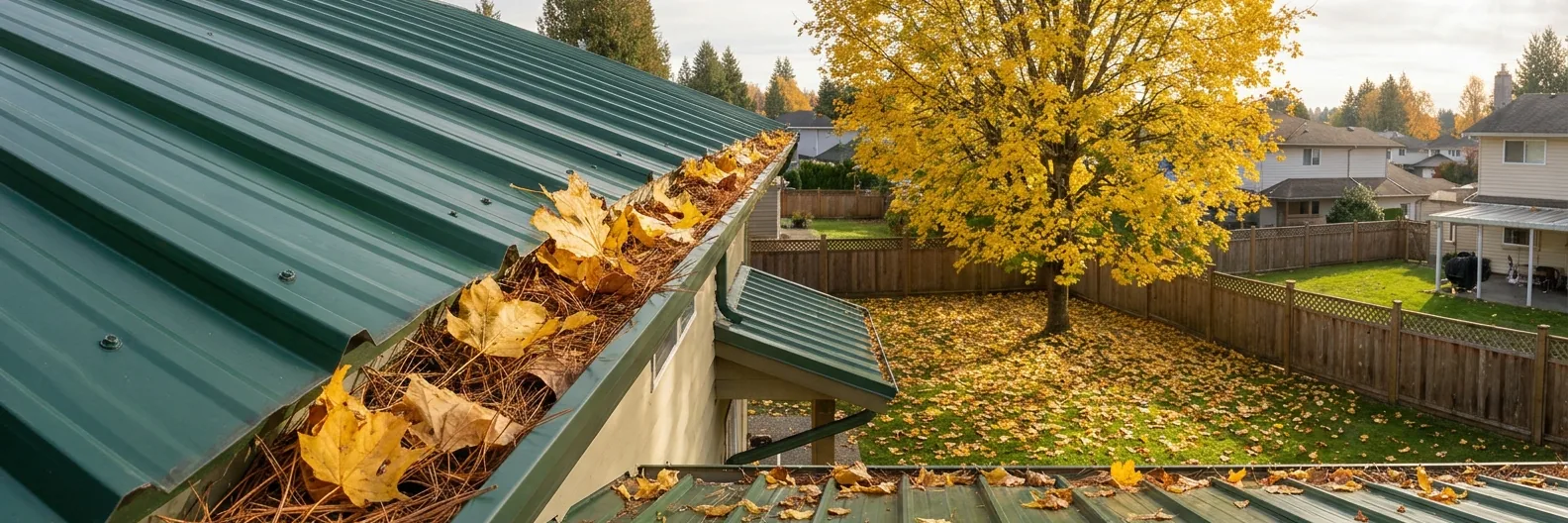
A metal roof needs less looking after than a shingle roof, not none. There is no moss treatment and no granule loss, but there are gutters that fill with fir needles, flashings and sealant that age, screws that work loose on a screw-down roof, and cut edges where rust can start. Most of what goes wrong is small, specific and cheap to fix if it is seen in time, and a yearly check from the ground and a ladder catches nearly all of it.
Prices below are typical 2026 Lower Mainland prices, CAD, before GST. The repair prices below are for roofs in general, mostly shingle; metal repairs are quoted on site.
The yearly check
Late autumn, after the needles have come down, and again after any big wind. From the ground with binoculars, then from a ladder at the eaves, look for:
- Debris in valleys, behind chimneys, against skylights and in the gutters.
- Flashings at chimneys, walls, pipes and vents: lifted edges, open joints, staining below.
- Sealant at penetrations and closures: cracked, shrunk or pulled away.
- Fastener heads on a screw-down roof: standing proud, missing or showing rust rings.
- Scratches, dents and rust streaks, especially at eaves, rakes and cut edges.
- Snow guards, vents and anything bolted on: still tight, still sealed.
- Panel movement after wind, or a ridge cap that has opened.
- Inside the attic: stains on the underside of the deck, damp insulation, daylight.
Do not walk a wet metal roof. Painted metal with rain or frost on it is as slippery as a surface gets, and WorkSafeBC requires crews to use fall protection wherever a fall of 3 metres or more is possible. If something needs a closer look, a written roof inspection runs $150 to $400, and insurers ask for maintenance records when a roof claim is made.
Debris and gutters
FireSmart BC's advice to clean needles, leaves and other combustible debris from the roof and gutters regularly applies to metal roofs as much as any other, and there is a second reason on metal. A drift of fir needles in a valley holds water against the paint for months, and corrosive runoff is an exclusion in every paint warranty we know of. Keeping valleys and the uphill side of chimneys clear is the most useful thing an owner can do for a metal roof.
Gutters on a metal roof fill faster than owners expect, because nothing slows the debris on the way down. Gutter cleaning runs $150 to $400 for a typical house and $400 to $800 for a large or tree-heavy one. Mesh or screen gutter guards cost $4 to $12 per linear foot installed and micro-mesh guards $12 to $28. If the gutters themselves are done, seamless aluminum gutters run $10 to $25 per linear foot; see our gutters, soffit and fascia service. A blocked downspout backs water up under the eave flashing in a heavy rain, so keep those clear too.
The fastener walk on screw-down roofs
An exposed-fastener roof is held on by screws driven through the face of the panel, each sealed by a rubber washer under its head. Every sunny day the panel expands and every night it contracts; over years that movement works the screws in their holes and the sun hardens the washers. A screw that has backed out or lost its washer is a drip, and on a roof with hundreds of them a few will be loose at any check.
The remedy is a walk-over every few years, more often on a south-facing roof or an agricultural building in 26 or 29 gauge, where the thin panel moves more. We re-drive what is loose, replace stripped screws with the next size up, replace hardened washers and reseal the laps where they have opened. The common owner mistake is over-tightening, which dishes the panel and splits the washer. We do this work on roofs we did not install.
A standing seam roof has no fasteners in the weather. The clips are under the seams, and the only exposed screws are at trims, closures and the ridge; those few are the ones to check.
Sealant: where it belongs and where it does not
Sealant on a metal roof is a wearing part. It belongs where the design puts it: under laps, inside ridge and eave closures, behind counterflashing, around pipe boots and at trim joints, out of the sun.
Where it does not belong is on the surface, smeared across a seam or around a screw head to stop a leak. That is the repair we are most often called to undo. Surface sealant fails in a season or two and hides the real cause, which is nearly always a backed-out screw, an open lap or a flashing that has moved. Fix the cause, then reseal in the right place.
Use a sealant made for metal roofing and compatible with the panel's paint, and nothing else. We do not put asphalt roof cement on painted metal, and we do not glue anything to a panel: adhered add-ons are a paint warranty exclusion, and that includes stick-on snow pads and mounts. When sealant at a penetration has cracked or shrunk, cut it out and replace it rather than adding a bead over the old one.
Rust at cut edges and scratches
Painted steel rusts where the steel is exposed, not where the paint is sound: cut edges at the eaves, rakes and around penetrations, scratches from a ladder or a dropped tool, fastener holes, and anywhere a different metal touches the panel.
Under the paint, Galvalume steel normally carries a 25.5-year corrosion warranty and aluminum 20 years; the PVDF paint over it is warranted 20 to 40 years for film adhesion and 10 to 30 years against chalk and fade. None of that covers galvanic contact, so a copper pipe draining onto a steel roof or a bare steel bracket bolted through a painted panel will show rust first, and the warranty will point to the bracket.
What to do: hem raw edges where they can be hemmed, touch up scratches sparingly with the manufacturer's matching paint (a dab beats a brushful, since touch-up weathers differently from the factory finish), and get any other metal off the roof. A rust streak below a fixture is a sign, not a stain. Near salt water all of this happens sooner, and our guide on metal roofs near the ocean covers the extra steps.
Snow guards, solar and anything added later
Most leaks on a standing seam roof we are called to trace to something added after the roof was finished: a satellite dish, a vent cut in by another trade, a solar rail screwed through the pan. Every added penetration should go through a roofer who knows the panel.
Standing seam makes this easy. Clamps grip the seam with no penetration at all, with published holding capacities from about 300 to about 4,000 pounds depending on the seam and clamp, and solar panels can be mounted rail-less on them. The same applies to snow retention: industry guidance is blunt that bent-sheet-metal snow stops often bend, fold and collapse, so engineered clamp-on systems are the ones to use. We size and place them under our snow guards and accessories service.
Condensation that looks like a leak
Not every drip is a leak. On a shop, barn or arena with panels on open framing, warm moist air inside meets a cold panel on a clear night and condenses on the underside, and in the morning it rains indoors. The fix is not sealant; it is ridge and eave venting, a vapour barrier or an anti-drip fleece under the panels.
Houses do the same thing in the attic if the ventilation is short. The code calls for unobstructed vent area of at least 1/300 of the insulated ceiling area, 1/150 for low-slope and joist-framed roofs, split between the top and bottom of the space. Blocked soffit vents, insulation pushed into the eaves or a bathroom fan dumping into the attic will wet a metal roof from inside. Our roof ventilation service sorts this out.
When to call, and what repairs cost
Call when you see an active drip or a spreading ceiling stain, screw heads standing proud on a shop roof, a panel or ridge cap lifted after a wind, rust at an edge, sealant split at a pipe or skylight, or a hole cut by another trade. Call before winter rather than after: one national repair guide puts a 15 to 25% premium on winter emergency work.
Typical Lower Mainland repair prices, for roofs in general and mostly shingle, give a sense of scale:
| Repair | Typical range |
|---|---|
| Leak repair | $400 to $1,500 |
| Chimney flashing repair | $400 to $1,800 |
| Pipe boot replacement | $250 to $600 |
| Valley repair | $600 to $2,500 |
| Emergency tarping | $350 to $1,000 |
| Partial re-roof or large section | $2,000 to $6,000 and up |
| Written roof inspection | $150 to $400 |
Metal repairs have no set price, because the job depends on the profile, the colour match and the access, so we quote after seeing the roof through our metal roof repair service, on roofs we installed and roofs we did not.
One more reason not to wait. Canadian insurers describe slow leaks from worn flashing as preventable, and one Canadian insurance guide says plainly that money spent on a yearly roof inspection could save thousands in a denied claim. A metal roof that is checked once a year will outlast the house's second owner. One that is never looked at will still outlast shingles, but it will leak first at the one screw nobody saw.
Next step
If your metal roof is due a look, or has a drip you cannot trace, book a free estimate and we will inspect it and give you a written quote for whatever it needs, including nothing. If the roof is beyond repair, the estimate tool emails you a range for a new one in a few minutes.
Sources
- FireSmart BC, Home Ignition Zone assessment
- Sheffield Metals, Metal roofing paint warranties
- S-5 blog, Northern Ontario winters are no match for ColorGard