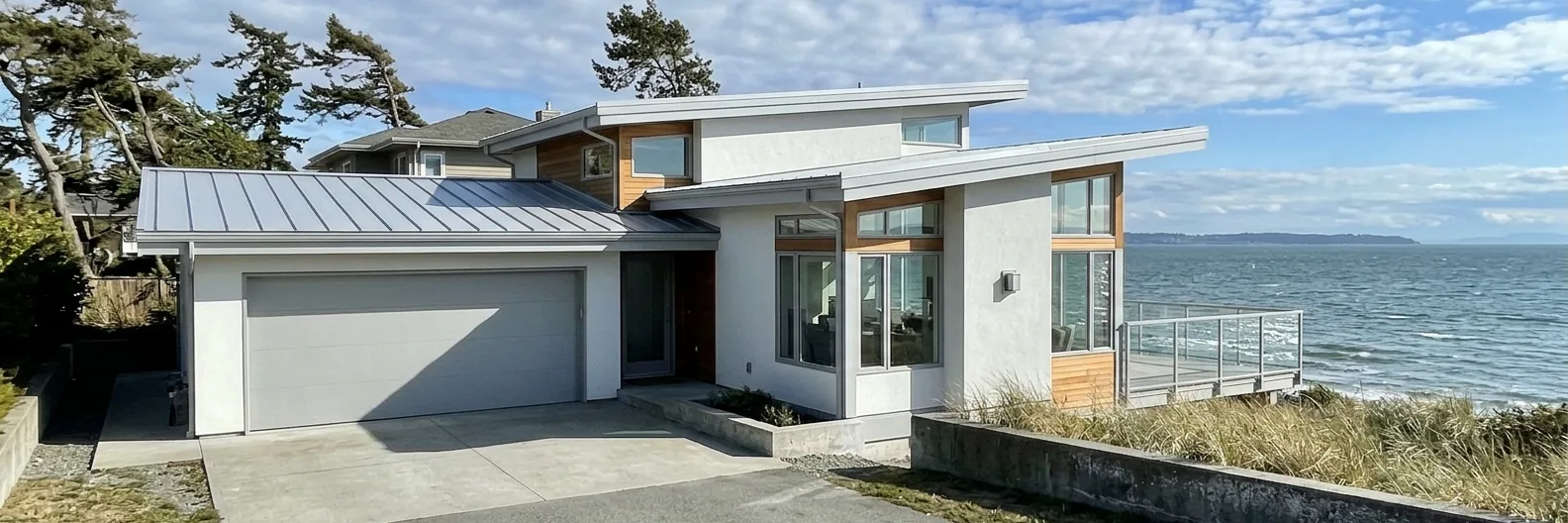
Steel standing seam costs $13 to $22 per square foot installed in the Lower Mainland and aluminum standing seam $18 to $28, at typical 2026 Lower Mainland prices, CAD and before GST. The reason to pay the difference is salt. The paint warranty on a steel roof excludes "breaking surf" exposure, the steel under the paint is warranted against corrosion for 25.5 years and no longer, and a roof that faces open water in West Vancouver, White Rock or Tsawwassen is exactly the roof those exclusions were written for. Aluminum does not rust, so on the waterfront it is usually the answer.
That is the short version. The longer version is that most of the Lower Mainland is not waterfront, that steel is the right roof almost everywhere inland, and that the details at the edges and fasteners decide more than the choice of metal. This guide covers what the warranties say, where rust starts, the case for aluminum, and which neighbourhoods we treat as salt-exposed.
What the warranty actually says
A painted steel roof carries two warranties, and both have fine print.
The paint warranty is the one people quote. PVDF finishes (Kynar 500 and Hylar 5000 are the trade names) are warranted for 20 to 40 years for film adhesion, and for chalk and fade for 10 to 30 years. SMP paint is sold on a "40-year" warranty that applies to film adhesion only. Plain polyester is 20 years or less on adhesion and about 10 on colour.
The substrate warranty is the one that matters near the water. Galvalume steel normally carries a 25.5-year warranty against corrosion. An aluminum substrate carries 20 years. Painted galvanized steel often carries none.
Then the exclusions, which the industry explainer we rely on lists as coastal "breaking surf" exposure, corrosive runoff, galvanic contact with other metals, and add-ons adhered to the panel. There is no distance in metres in that wording, and the manufacturers do not give one. Whether a given address falls inside that exclusion is a question for the manufacturer, which is why we ask for the answer in writing before quoting steel on any property that faces open water. If a roofer tells you the warranty covers your waterfront house without having asked, they have not read it.
Where rust starts on a steel roof
Rust rarely starts on the face of a panel. The face is painted, and in this region it is rinsed by 1,159.5 millimetres of precipitation over about 170 days a year, which washes salt off before it does much. Rust starts where the steel is exposed or where the salt stays.
- Cut edges. Every panel is cut at the eave, the rake and around every penetration. A raw cut edge at the eave, facing the wind, is the first place a steel roof shows red on the coast. We hem the eave edges over a drip flashing so the cut is folded inside, and we treat rake and penetration cuts the same way.
- Scratches. A dragged ladder or a dropped tool through the paint exposes the steel. Touch-up paint helps; a scratch left bare does not.
- Fastener holes. An exposed-fastener roof puts hundreds of screw holes through the sheet, each sealed by a rubber washer that ages in the sun. Near salt water that is hundreds of places for corrosion to begin, and it is why we do not recommend exposed-fastener panels within reach of spray.
- Galvanic contact. Two different metals touching in the presence of salt water corrode each other. A copper gutter draining onto steel, a steel screw in an aluminum panel, a lead flashing against a painted pan: all are excluded from the warranty and all cause trouble sooner on the coast.
- Places rain does not reach. Under deep eaves, behind chimneys, on the lee side of dormers and in valleys full of fir needles, salt lands and is never rinsed. Those are the spots to hose down once or twice a year and to keep clear of debris, since corrosive runoff from rotting needles is also outside the warranty.
Aluminum against steel
Aluminum does not rust. It oxidises, and the oxide is a thin grey-white layer that stays in place and protects the metal beneath, rather than flaking away as iron rust does. That single fact is why aluminum standing seam and aluminum shingles are the waterfront roofs of this region, and why an inspectors' lifespan chart puts copper, which behaves similarly, at over 100 years.
The cost difference is real but not large against the whole job:
| Steel standing seam | Aluminum standing seam | Aluminum interlocking shingles | |
|---|---|---|---|
| Installed, per sq ft | $13 to $22 | $18 to $28 | $16.64 to $21.43 on BC contracts, median $18.47 |
| Whole roof | $24,000 to $40,000 for 2,000 sq ft | Aluminum and complex roofs run to $50,000 to $67,000 | Median $48,700 for a roof of about 2,800 sq ft; middle half $39,100 to $77,400 |
| Substrate warranty | 25.5 years against corrosion | 20 years | One BC aluminum shingle maker offers a lifetime limited warranty, transferable once with 50-year coverage on transfer |
Two honest caveats. On paper, the aluminum substrate warranty is shorter than Galvalume's, 20 years against 25.5, and the breaking-surf exclusion sits in the paint warranty for both; the case for aluminum is the metal's behaviour, not the paperwork. And aluminum is softer than steel, so it dents more easily and it wants a solid deck under it rather than open framing. On a house with plywood under the panels neither point changes the decision.
Copper and zinc are the third option, for owners who want a roof that weathers rather than one that stays a colour. Both are quoted on site, because metal prices and detailing vary from roof to roof. Our aluminum, copper and zinc page describes where each belongs.
Which neighbourhoods we treat as salt-exposed
There is no official map, so this is our working list: properties that face open water and take the wind off it.
- West Vancouver: the waterfront from Ambleside through Dundarave to Horseshoe Bay, and the first rows above Marine Drive where the wind comes straight off Burrard Inlet and Howe Sound.
- North Vancouver: Deep Cove and Dollarton on Indian Arm and the inlet. The water is more sheltered than the open strait, but it is still salt, and the heavy tree cover means debris sits on roofs longer.
- White Rock: the bluff and Marine Drive, facing Semiahmoo Bay with nothing between the roof and the sea. The hillside streets above take the same wind.
- Delta: Tsawwassen, from the Boundary Bay side to the bluffs facing the Strait of Georgia and the ferry causeway. Beach Grove and Boundary Bay itself are flat and exposed.
- Richmond: the dyke-side streets of Steveston and the west dyke, which face the river mouth and the strait. Inland Richmond, a few blocks back, is ordinary steel territory.
- Also Point Grey and the Kitsilano waterfront in Vancouver, Crescent Beach in Surrey, and Belcarra and the Barnet shoreline in the Tri-Cities.
Behind those first rows the exposure falls away quickly. In Surrey, Langley, Abbotsford, Chilliwack and the whole valley east of the river mouth, salt is not a factor, steel with a PVDF finish is the right roof, and paying for aluminum there is money that does nothing.
Details that matter more than the metal
Whichever metal you choose, these are the items we build into a coastal roof, and the items to ask any roofer about:
- Hemmed edges everywhere. No raw cut edge at the eave or rake.
- Compatible fasteners and clips. Stainless or coated fasteners matched to the panel metal, so there is no galvanic pair anywhere in the system.
- Flashings in the same metal. A steel roof with aluminum trim, or the reverse, is a galvanic pair along every edge.
- Gutters that match. Seamless aluminum gutters run $10 to $25 per linear foot installed, and aluminum gutters on an aluminum roof keep the whole edge in one metal. Copper gutters on a steel roof are a mistake.
- Nothing stuck to the panel. Adhered add-ons are a warranty exclusion; snow guards and solar mounts should clamp to the seam, not glue to the pan.
- A rinse where rain does not reach. A garden hose under the eaves and behind chimneys once or twice a year.
When steel is still fine near the water
Not every house with a sea view is a breaking-surf address. A second-row house in Dundarave, a Deep Cove house in the trees, a Steveston house a few blocks from the dyke: on these we will often quote both metals and let the cost difference decide. Steel standing seam with a PVDF finish, hemmed edges, compatible fasteners and a yearly rinse will serve well in moderate exposure, with the understanding that the manufacturer may not cover that exposure in writing. Where the house takes the full wind off the water, we quote aluminum and we explain why.
Either way, the standing seam system is the same: concealed clips, no fasteners in the weather, and seams that are the roof's only joints. Our guide to metal roof lifespan, paint and gauge covers the warranties in more depth, and our maintenance guide covers the yearly check.
Next step
If your house faces the water, book a free estimate and we will look at the exposure, the edges and the existing metals on the roof before quoting steel, aluminum or both. For a quick range on either metal, the estimate tool emails you a price in a few minutes.
Sources
- Sheffield Metals, Metal roofing paint warranties
- Interlock Roofing, Product brochure
- InterNACHI, Estimated life chart for roofing
- Climate of Vancouver (ECCC 1991 to 2020 normals)