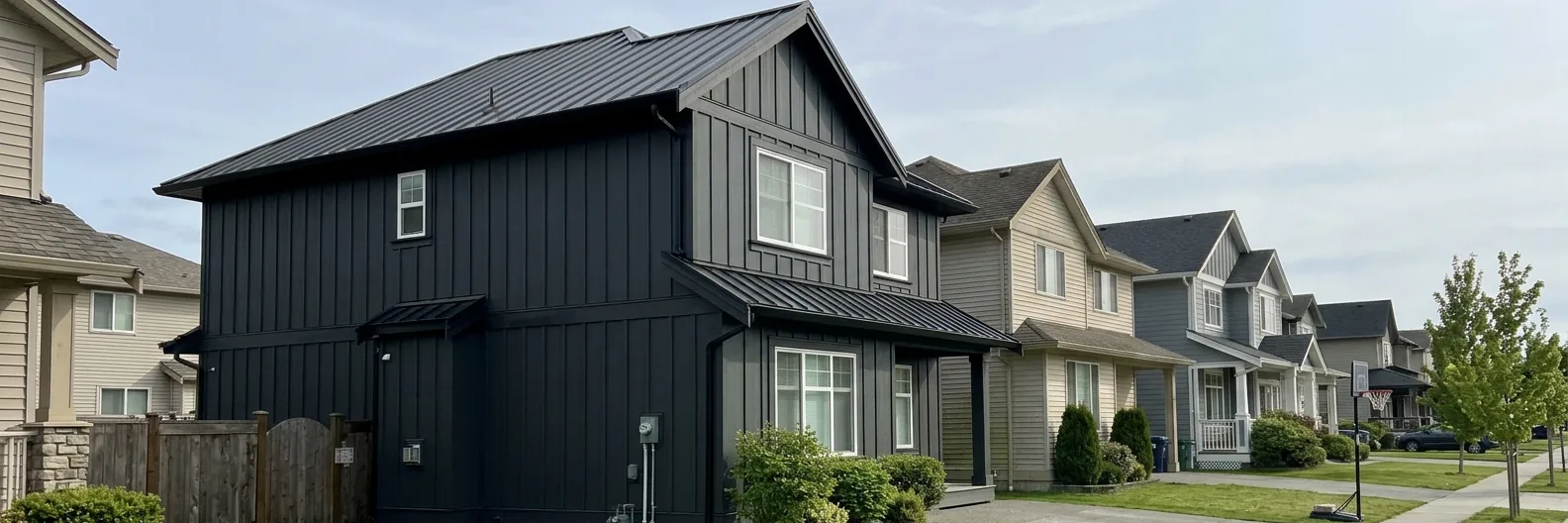
Installed in the Lower Mainland, standard vinyl siding runs $7 to $14 per square foot, James Hardie fibre cement lap $10 to $20, and metal wall cladding $15 to $25 for standing seam or flat panels, with woodgrain aluminum plank from $15 and premium plank systems at $25 to $40. All figures are typical 2026 Lower Mainland installed prices, CAD, before GST. On a house with roughly 2,000 square feet of wall, that is $12,000 to $20,000 for vinyl and $19,000 to $40,000 for Hardie. Metal has no fixed whole-house figure, and we explain why below.
Metal is the most expensive of the three on the day it goes up, and it is the only one of the three we install. So this guide is written to show where that money goes, where it comes back, and where it does not. Vinyl and Hardie each have cases they win, and we name them at the end.
Installed cost, side by side
| Cladding | Installed, per sq ft | About 2,000 sq ft of wall | Notes |
|---|---|---|---|
| Vinyl, standard | $7 to $14 | $12,000 to $20,000 | Premium or insulated vinyl $10 to $16 |
| James Hardie lap (HardiePlank) | $10 to $20 | $19,000 to $40,000 | Vancouver proper runs $12 to $24; Fraser Valley and Tri-Cities from about $9.50 |
| Metal standing seam or flat wall panels | $15 to $25 | Quoted on site | Openings and corners move the total |
| Woodgrain aluminum plank | From $15; premium systems $25 to $40 | Quoted on site | Mostly used on features rather than whole houses |
| Metal corrugated, ribbed or board and batten | Quoted on site | Quoted on site | Openings, corners and wall height decide the price |
| For reference: cedar bevel | $14 to $26 | $24,000 to $60,000 | Vancouver $16 to $30, Fraser Valley $12 to $18 |
| For reference: LP SmartSide | $9 to $16 | $18,000 to $32,000 | Engineered wood |
Three things sit behind that table. Most per-square-foot rates already include standard rainscreen strapping and basic trim, and many include removal of the old siding; where a quote leaves those out, removal adds $1 to $4 per square foot and rainscreen $1.50 to $4. Suburban and Fraser Valley prices commonly run 10 to 40% lower than Vancouver proper for the same material. And a two-storey house adds 20 to 30% for scaffolding, whatever the cladding.
Metal walls are harder to put a single number on, and that is not an accident. We measure these in person, and the quote depends more on the corners and openings than on the panel itself. Our siding cost guide has the full tables.
Painting: the cost that separates them after year 15
This is the line most comparisons skip.
Vinyl is never painted; the colour is in the plastic, and it fades at whatever rate the sun dictates. Hardie arrives primed or factory-coloured and needs a field re-coat in time. A Hardie re-coat runs $4,000 to $9,000 per cycle, with the first one typically due around year 20. Cedar, for comparison, is painted or stained every cycle at $3 to $5 per square foot, or $6,600 to $11,000 per cycle on a 2,200 square foot house.
Metal arrives with its paint baked on. The PVDF finishes we install carry warranties of 20 to 40 years for film adhesion and 10 to 30 years against chalk and fade. SMP paint is sold on a "40-year" warranty, but that figure applies to film adhesion only, with weaker colour ratings, so ask which paint is on the quote. The exclusions matter too: breaking-surf exposure, corrosive runoff and contact with other metals are outside every paint warranty we know of. Within those limits, a metal wall has no painting cycle at all, and the day-one gap between a Hardie wall and a metal wall narrows sharply at the first re-coat and is gone by the second.
Rot, and what sits behind the siding
None of the three rots. Vinyl is plastic, Hardie is cement and cellulose fibre, and metal is metal. What rots is the wall behind them, and the thing that protects it is the rainscreen: the strapped cavity and house wrap that the BC code requires behind cladding, so that water getting past the siding drains out instead of soaking the sheathing.
The money here is large. Rot repair once wall cavities are compromised can run $40,000 to $80,000. On 1980s and 1990s homes it is wise to budget $2,000 to $8,000 for hidden repairs, or a 15 to 20% contingency. Sheathing repair itself runs $4 to $8 per square foot of repair area. Compared with that, the $1.50 to $4 per square foot a rainscreen adds is small, and we build it into the base rate.
Each cladding has its weak point for water. Hardie is vulnerable at cut ends and butt joints, which need sealing and caulking that is kept up. Vinyl is vulnerable at the J-channel around windows, where water runs down the trim and behind the panel. Metal is vulnerable at its flashings and its bottom edge, which is why we hem the lower edge over a drip flashing and why the window and door head flashings matter. Window and door flashing is priced per opening and is easy to leave out of a per-square-foot rate, so make sure any quote says what happens at the openings.
Fire
FireSmart BC's description of its home rebates lists "upgrading to fire-resistant siding, windows and/or roofing materials" among eligible work. Metal does not burn. Fibre cement does not burn. Vinyl is a plastic, and plastic softens in heat well before anything else on the wall is affected. We have no reliable fire class to quote for the three as wall claddings, so we will not give one, but for a house against the forest edge in Mission, Hope, the Chilliwack hillsides or the North Shore, we would choose metal or Hardie over vinyl on this point alone.
Dents, cracks and chips
Metal dents. A ball, a ladder or hail leaves a mark, the mark is cosmetic, and it does not leak. Heavier gauge resists better: in roofing terms, 24 gauge carries about 30% more steel than 26 gauge. Woodgrain aluminum plank is softer than steel, which is one reason it is so often used on soffits, entries and upper storeys rather than at ground level.
Vinyl cracks, especially when struck cold. The difference between builder-grade vinyl at 0.040 inches and premium insulated vinyl at 0.046 to 0.052 inches is about $2 to $2.50 per square foot in material, and vinyl installed for under $8 per square foot is usually the thin grade. Thin vinyl is a thin wall.
Hardie is heavy and brittle at its edges. Corners and bottom edges chip when they are hit, and the remedy is to replace the board. Repairs are priced similarly for any cladding: a minor repair of one to five boards runs $500 to $2,000, and replacing one wall section or elevation $2,000 to $8,000.
Looks
Vinyl shows a lap joint wherever two panels meet, and a long wall shows many of them. Hardie reads as painted wood, in lap, shingle, panel and board and batten profiles, and it is the cladding of choice where a street is all painted wood. Metal reads as metal: long unbroken panels, sharp shadow lines, and one colour along the whole wall. Standing seam walls suit the flat, dark, modern houses being built across the region; metal board and batten gives the farmhouse look without a painting schedule; corrugated and ribbed panels suit shops, barns and the industrial look; and aluminum plank gives the warmth of wood at soffits and feature walls. Many of the best facades we see pair a Hardie body with metal accents, and we are glad to work alongside another cladding.
When each one wins
Vinyl wins when the budget decides. At $12,000 to $20,000 for a 2,000 square foot wall it is half the price of anything else, it never needs paint, and for a rental or a house you will sell soon it is the sensible answer. Vinyl prices have crept up in BC since 2023, and thin vinyl is less suited to the colder Fraser Valley, so buy the thick grade.
Hardie wins when the house should look like painted wood. Heritage streets, strata complexes that require a match, and buyers who want a traditional lap all point to fibre cement. Budget a re-coat around year 20 and it is a long-lived wall.
Metal wins when you are staying, and when you never want to paint. It pairs with a metal roof, it is the natural cladding for a modern house or a farmhouse, it does not burn, and it is the only one of the three with a factory finish warranted for decades. It also wins on large, plain walls, where the panel does the work and the trim count is low.
Metal loses when the walls are cut up. A house with many small windows, bays and bump-outs is mostly trim, and trim is where the labour goes. There we will tell you the number before you decide, and sometimes we will tell you that Hardie is the better buy. See our metal siding page for the profiles we install.
Next step
If you want a figure for your own walls, book a free estimate: we measure the house in person, count the openings and corners, check what is behind the old siding and give you a written quote. If a metal roof is also on the list, the estimate tool gives you a roof range by email in a few minutes.