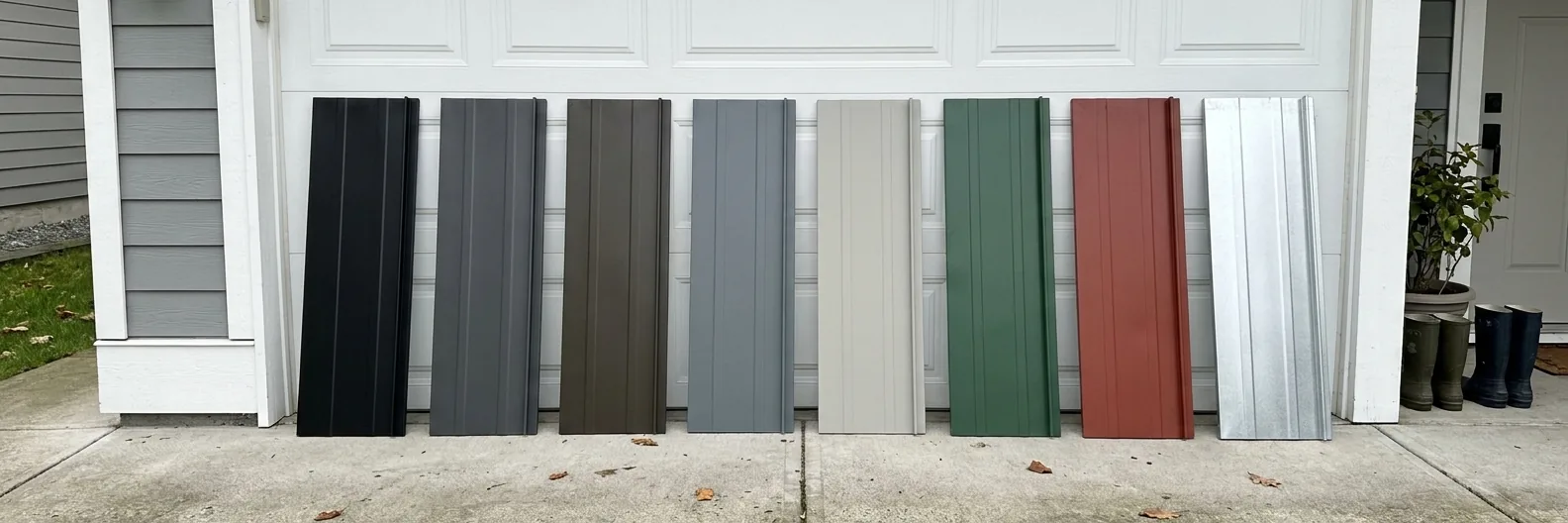
The colour of a metal roof is the decision you will look at every day for 40 years, and it is also the one most people make from a chip the size of a business card. The finish under the colour matters more than the colour itself. A PVDF paint holds its shade and its surface for decades; an SMP paint carries a bigger warranty number and fades and chalks sooner. Choose the finish first, then the colour, then check both against the siding, trim and gutters they will sit beside.
This guide covers the fade and chalk ratings that separate PVDF from SMP, how dark and light colours behave on a Lower Mainland roof, matching the roof to walls and trim, bare Galvalume and the natural metals, and what still looks right after 20 years. We make no claims about energy savings or cooler attics from light colours: the research we work from does not measure that for our climate, and BC offers no rebate for roof colour, so we leave it out rather than guess.
To see every colour and print we install, with where each one is used, open our colour chart.
Finish first: PVDF against SMP
Metal roof paint comes in three grades. PVDF (the trade names are Kynar 500 and Hylar 5000) is the premium. SMP, silicone-modified polyester, is the mid-range. Plain polyester is the economy finish. Their warranties are written in two parts, film adhesion (the paint staying on the metal) and colour (chalk and fade), and the colour part decides how the roof looks.
| PVDF | SMP | Polyester | |
|---|---|---|---|
| Film adhesion warranty | 20 to 40 years | 40 years | 20 years or less |
| Chalk and fade coverage | Generally 10 to 30 years | Shorter than the adhesion term | About 10 years on colour |
| Fade limit (delta E) | 5 in a published 30-year example | 7 on roofs | Not stated |
| Chalk limit (rating) | 8 in the same example | 6 | Not stated |
Delta E is the standard measure of colour change, and a lower number means less change; chalk is rated on a scale where a higher number means less chalk. PVDF's 5 and 8 are tighter than SMP's 7 and 6. Put plainly, a PVDF warranty promises the colour will stay closer to the chip for longer, and the SMP "40-year" headline is about the paint not peeling, not about the colour staying put.
For a house, a strata building or any roof seen from the street, we specify PVDF. For a barn or a shop roof, SMP in a mid-grey is a fair saving. Our guide to metal roof lifespan, paint and gauge explains the substrate and gauge choices that go with it.
What fade and chalk look like
Fade is the colour shifting, usually lighter, as the pigments break down under UV. Chalk is the resin at the surface breaking down into a pale powder that sits on top of the paint; you can wipe it off with a finger, and rain streaks it. Both happen fastest on the slopes that get the most sun, so a roof can end up two shades: the south and west faces lighter and dustier, the north face closer to the original.
- Chalk shows most on dark colours, because the powder is pale. Black and charcoal in SMP are the classic case.
- Fade shows most on saturated colours, because there is more colour to lose. Strong reds, blues and greens move further than greys.
- Mid-greys, light greys and whites hide both. They are the forgiving colours in SMP and look close to unchanged in PVDF.
If you want a dark or strong colour, that is an argument for PVDF, not against the colour.
Dark or light: how they behave here
Vancouver airport records precipitation on 169.5 days a year, 1,159.5 mm of it. What a colour looks like after years of that matters more than how it looks on a sunny showroom day.
Dark roofs (black, charcoal, dark brown, dark green) hide dirt, the streaks that run below vents and skylights, and the stain line where water sheets off a dormer. They show chalk and fade more, and pollen and dust in a dry spell. Many new builds in Vancouver and Burnaby are going dark, and dark standing seam with matching wall panels is the look of the moment on infill houses and laneway homes.
Light roofs (white, light grey, bone, sand) hide chalk and fade almost completely. They show everything else: the green film of algae on a shaded north slope, needle stains under conifers, rust streaks from a steel screw or a bare cut edge, and the drip line below a chimney. Shade slows a roof's drying after rain, so a light roof under big trees on the North Shore or in Maple Ridge will need rinsing to stay light.
Mid-tones (slate grey, pewter, weathered zinc, taupe, mid-brown) are the compromise and the colours that age best in both finishes. They hide dirt reasonably, show chalk little and fade least.
Heat. We are often asked whether a light roof keeps the house cooler or a dark one cuts heating. We have no Lower Mainland measurement to point to, so we make no claim either way, and there is no provincial or utility rebate in BC for cool roofs or roof colour. Choose the colour for how it looks and ages.
Matching siding, trim and gutters
A metal roof is rarely alone. It meets fascia, gutters, soffits and window trim, and increasingly it meets metal siding. Three approaches work:
One colour, roof and walls. A standing seam roof with standing seam wall panels or metal board and batten in the same colour from the same coil. This is the modern-house look, nearly always in a dark grey or black, and because every panel comes from the same paint run it ages evenly. Standing seam wall panels run $15 to $25 per square foot installed.
Roof dark, walls light. A charcoal or black roof over white, grey or sage Hardie, stucco or wood, with trim and gutters matched to the roof. The roof frames the house and the light walls hide nothing the roof would show. Gutters, downspouts, fascia and soffit in the roof colour tie it together; see gutters, soffit and fascia.
Roof as a quiet backdrop. A mid-grey or weathered-zinc roof under warm wood or woodgrain aluminum plank siding. The roof recedes and the wall does the talking. Aluminum plank siding starts around $15 per square foot installed, with premium systems at $25 to $40.
Two practical points. Bring a full-size panel sample to the house and look at it against the walls in flat light and in sun; a chip in a showroom tells you very little. And keep the metals compatible: an aluminum gutter against bare steel, or a steel screw in an aluminum panel, is galvanic contact, which is a paint warranty exclusion and the start of rust.
Bare Galvalume and mill finish
Not every metal roof is painted. Bare Galvalume (steel with its aluminum-zinc coating and no paint) is a legitimate finish, common on farm buildings and increasingly chosen on modern houses for a raw look. There is no paint to chalk or fade, so the colour question becomes a weathering question: a new panel is bright with a visible spangle, and it dulls to a flatter grey over time. The Galvalume substrate normally carries a 25.5-year corrosion warranty, which is the only warranty a bare panel has.
Bare panels show handling marks, fingerprints and water staining more than painted ones in the first season, and they are not for the waterfront: breaking surf is an exclusion on steel of any finish. Where a client wants the raw-metal look near the ocean, we point them to aluminum or zinc.
Copper, zinc and the natural metals
Copper and zinc are unpainted and change colour on purpose. Copper starts bright, goes brown, and over many years develops its green patina; zinc goes from a blue-grey sheen to a soft matte grey. The general reference life for copper is over 100 years. They are the finishes that age best of all, because ageing is what they are meant to do, and the most expensive. Copper and zinc roofing are quoted on site, because metal prices and detailing vary from roof to roof; see aluminum, copper and zinc. One caution: copper runoff is corrosive to steel and Galvalume, so copper flashings or gutters draining onto a steel roof void the paint warranty.
Colour and cost
Standard colours within a finish cost the same as each other. PVDF costs more than SMP, and the premium is built into the per-square-foot price of the system rather than listed separately. The price ranges on this site assume a PVDF finish: steel standing seam $13 to $22 per square foot, aluminum $18 to $28, metal shingles $12 to $22, exposed-fastener panels $8 to $14, all CAD, installed, before GST, at typical 2026 Lower Mainland prices. Custom colours, metallic finishes and matte textures are available from most coil suppliers and are quoted on site, because the price depends on the coil run.
Heritage houses and permits
In the City of Vancouver, installing roofing on a house needs no permit, but a heritage-listed house or one in a heritage area may need a Heritage Alteration Permit before the roof's material or appearance changes, and colour is part of appearance. Ask the City before ordering. On character houses we usually go to a shake- or slate-profile metal shingle in charcoal, slate grey or weathered brown, which keeps the roof reading the way the street expects.
What ages well: our short list
- PVDF over SMP on anything you will look at.
- Mid-greys, charcoal and weathered-metal tones over saturated colours, unless the saturated colour is in PVDF and you accept it will soften.
- Low-gloss and matte finishes over high gloss, which shows every ripple and chalk patch.
- Roof, trim, gutters and wall panels from the same coil and finish wherever they share a colour.
- Nothing glued to the paint. Adhered add-ons are a warranty exclusion; snow guards and mounts should clamp.
- Compatible metals only: aluminum with aluminum, steel with steel, copper with copper.
- A rinse of the shaded slopes every year or two on light colours.
Next step
Bring your siding colour, or a photo of the house, to a free estimate and we will bring full-size panel samples in the finishes that suit it. For a budget range first, the estimate tool lets you outline the roof and choose a system, and emails you a range in a few minutes.
Sources
- Sheffield Metals, Metal roofing paint warranties
- This Old House, How long does a roof last
- InterNACHI, Estimated life chart for roofing
- Climate of Vancouver, Environment and Climate Change Canada 1991 to 2020 normals