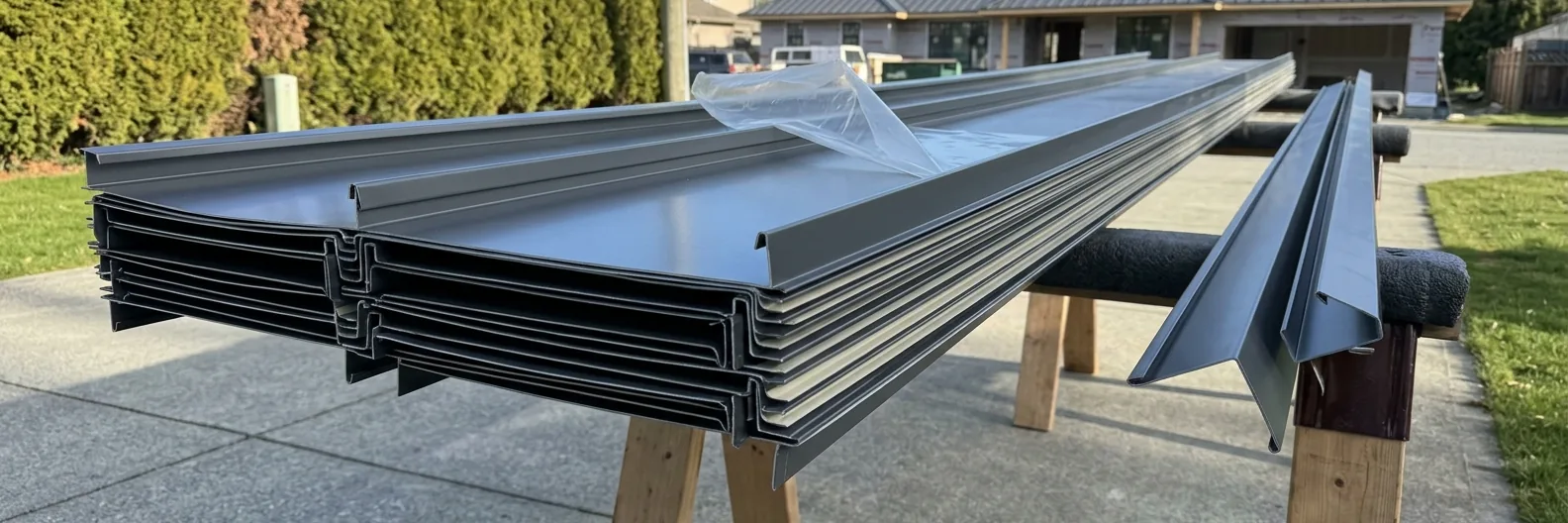
How long a metal roof lasts depends on three things you can read straight off a quote: the paint system, the metal under the paint, and the gauge. The general reference figure is 40 to 80 years for a metal roof, against 15 to 25 years for basic asphalt shingles, and the spread is wide because those three choices move the number a long way. A 24 gauge Galvalume steel panel in a PVDF finish is a different roof from a 29 gauge sheet in polyester paint, even though both are sold as "metal".
The second thing to know is that the warranty on the paint is not a prediction of how long the roof will last. A "40-year" SMP warranty covers the paint staying stuck to the metal for 40 years, and nothing else. This guide explains the paint systems, the substrates and the gauges, and what the headline warranty covers and leaves out, so you can compare two metal quotes on what they are offering.
Where the lifespan figures come from
The life expectancies repeated online come mostly from the estimated-life chart published by the home inspectors' association InterNACHI and the contractor surveys built on it. Those give metal roofing 40 to 80 years, architectural asphalt shingles about 30 years, three-tab shingles about 20, and copper over 100 years. A Canadian insurance comparison site puts asphalt shingles at 15 to 30 years depending on quality. None of these figures are BC-specific, and we know of no BC service-life study for metal roofing, so treat them as general references rather than promises. What we can say with confidence is which end of the 40 to 80 range a particular roof is heading for.
The three layers of a painted panel
A painted steel roofing panel is a sandwich: a steel core, a metallic coating on both faces that stops the steel from rusting (Galvalume, an aluminum-zinc alloy, or galvanized, which is zinc), and a paint system on top. Aluminum panels skip the metallic coating, because aluminum does not rust the way steel does. Each layer has its own warranty and its own way of failing:
- The paint fails by chalking (a pale powder on the surface), fading, or losing adhesion (peeling, cracking, flaking).
- The metallic coating fails by being used up, after which the steel beneath rusts, first at cut edges and scratches.
- The core fails only once the coating is gone, or when the gauge is too thin to stand up to dents and foot traffic.
PVDF, SMP and polyester
Three paint systems cover nearly every metal roof sold in BC. PVDF, sold under the trade names Kynar 500 and Hylar 5000, is the premium system. SMP, silicone-modified polyester, is the mid-range system and the one behind the widely promoted 40-year warranty, which applies to film adhesion only. Polyester is the economy finish.
| PVDF (Kynar 500, Hylar 5000) | SMP | Polyester | |
|---|---|---|---|
| Film adhesion warranty | 20 to 40 years | 40 years | 20 years or less |
| Chalk and fade coverage | 10 to 30 years | Shorter term, looser limits | About 10 years on colour |
| Fade limit (delta E; lower is less change) | 5 in the published example | 7 on roofs | Not stated |
| Chalk limit (rating; higher is less chalk) | 8 in the published example | 6 | Not stated |
| Where we use it | Houses, strata and commercial roofs | Exposed-fastener panels where budget decides | Rarely; sheds |
Delta E is the standard measure of colour change, and a lower number means the colour has moved less. Chalk is rated on a scale where a higher number means less chalk. PVDF's limits of 5 and 8 are tighter than SMP's 7 and 6, and that gap is the whole difference in practice: a dark SMP roof can chalk to a dusty, lighter shade while still inside its 40-year warranty, because adhesion is what the 40 years covers. Our guide to metal roof colours and finishes covers which colours show it most.
The substrate under the paint
Galvalume is the standard substrate for standing seam and for quality exposed-fastener panels. Galvalume substrates normally carry a 25.5-year warranty against corrosion, separate from and usually shorter than the paint warranty on top of it.
Aluminum needs no metallic coating and carries its own substrate warranty, typically 20 years. Its advantage is near salt water, where steel rusts at every cut edge and where steel paint warranties stop applying. It costs more: aluminum standing seam runs $18 to $28 per square foot installed against $13 to $22 for steel, CAD, before GST, at typical 2026 Lower Mainland prices. One BC manufacturer of aluminum shingles publishes a lifetime limited warranty that transfers once to the next owner, with 50-year coverage after the transfer, which shows how differently aluminum products are warranted from steel.
Galvanized steel is the older zinc-only coating. Painted galvanized panels often carry no substrate warranty at all. It still appears on low-cost agricultural sheets.
Copper and zinc are a separate category: no paint, a patina instead, and a general reference life of over 100 years for copper. See aluminum, copper and zinc.
A quote that names the paint but not the substrate has left out half the roof.
Gauge: 24, 26 and 29
Gauge runs backwards: the higher the number, the thinner the metal. For standing seam you will nearly certainly be buying 24 gauge steel, and the standard specification for standing seam over a wood deck is 24 gauge in a Kynar or PVDF finish. Exposed-fastener panels are sold in 29, 26 and 24 gauge, and low-end agricultural jobs are normally 26 or 29.
The difference is not cosmetic. A 24 gauge panel weighs about 30% more than 26 gauge, and that extra steel is what shrugs off a dropped tool or a falling branch and lets a roof be walked without creasing. Thin panels on wide purlin spacing also flex, and flexing works the fasteners loose.
Our rule is 24 gauge for every standing seam roof, 26 gauge or heavier for exposed-fastener panels on anything we would call a building, and 29 gauge only on a shed where the owner has chosen it knowing the trade.
What the 40-year warranty covers
Read the warranty document rather than the number. For the common SMP warranty:
- It covers film adhesion, meaning the paint not peeling, cracking or flaking off the metal, for 40 years.
- Chalk and fade are covered for a shorter term and only beyond the stated limits (delta E 7, chalk rating 6). A roof that fades within those limits is performing as warranted.
- The substrate has its own, separate term: 25.5 years for Galvalume, 20 for aluminum, often none for painted galvanized.
- It is a paint warranty. It says nothing about leaks, flashings, fasteners or workmanship. Those belong to the installer's warranty, which you should have in writing.
The standard exclusions matter in the Lower Mainland:
- Breaking surf. Coastal exposure to breaking surf voids the paint coverage on steel. This is why we put aluminum on waterfront roofs; our guide to metal roofing near salt water sets out where the line falls.
- Corrosive runoff. Water draining onto the panels from a copper pipe, a treated-wood deck, a chimney or an exhaust.
- Galvanic contact. Dissimilar metals touching: a steel screw in an aluminum panel, copper flashing on steel, an aluminum gutter against bare steel.
- Adhered add-ons. Anything glued to the paint, which is how many stick-on snow guards and some mounts are attached.
The last three are installation details. A roof can lose its paint coverage on the first day if the installer uses the wrong screws or lets a copper pipe drain onto steel. BC panel manufacturers each publish their own warranty documents and the terms differ between them. Ask for the document that matches the exact panel and finish on your quote, and read the exclusions before you sign.
Product warranty and workmanship warranty
A manufacturer's warranty covers the panel. The installer's warranty covers the work: seams, flashings, fasteners, penetrations and whether the roof leaks. A long paint warranty on a badly flashed roof is worth very little. In BC the roofing contractors' association, RCABC, runs the RoofStar Guarantee, which covers both workmanship and accepted materials for 5, 10 or 15 years and is backed by the contractor and the RCABC Guarantee Corp.; architectural sheet metal roof systems qualify for the 15-year term. Whatever warranty you are offered, ask who pays, for how long, for what, and what happens if the installer stops operating.
Where a metal roof wears first
A few places age before the rest on every metal roof in our climate: cut edges and scratches on steel, where rust starts; south and west slopes, which show fade and chalk first; the areas under trees, where needles hold water against the metal; and, on exposed-fastener roofs, the rubber washers under the screws. None of these shortens the life of a well-specified roof if they are looked at once a year; see our guide to metal roof maintenance and repair.
What this means for cost
| System | Installed, per sq ft | Specification we would write |
|---|---|---|
| Standing seam, steel | $13 to $22 | 24 gauge Galvalume, PVDF |
| Standing seam, aluminum | $18 to $28 | Aluminum, PVDF |
| Metal shingles | $12 to $22 | Steel or aluminum, PVDF |
| Exposed-fastener panels | $8 to $14 | 26 or 24 gauge Galvalume, SMP or PVDF |
| Architectural asphalt shingles | $5.50 to $9.50 | For comparison; about 30 years as a general reference |
All prices are CAD, installed, before GST, at typical 2026 Lower Mainland prices. On a 2,000 square foot roof, standing seam comes to $24,000 to $40,000 against $11,000 to $20,000 for architectural asphalt.
The arithmetic favours metal when you plan to keep the house. If you expect to sell within a few years, or the building is a shed that will be gone before any paint chalks, asphalt or a 29 gauge sheet can be the right call, and we will say so.
Next step
If you want a range for your roof, the estimate tool lets you outline the roof, pick a system and get a price range by email in a few minutes. For a firm quote, book a free estimate; we measure in person and name the gauge, substrate and paint system in writing, so the warranty you are buying is the one you expect.
Sources
- Sheffield Metals, Metal roofing paint warranties
- Western States Metal Roofing, Gauge thickness of metal roofing panels
- This Old House, How long does a roof last
- InterNACHI, Estimated life chart for roofing
- RCABC, RoofStar Guarantee terms